
Decision Guide
Why is my water heater leaking?
Where a water heater leak is coming from tells you what's wrong: fittings, the drain valve, the relief valve, or the tank itself. Causes, safety steps, and repair vs. replace.
It depends on where the water is coming from. Leaks at the pipe connections or drain valve are usually repairable. Water from the temperature and pressure relief valve's pipe points to excess pressure or heat. Water seeping from the tank body, often with rust, means the tank has corroded through and the water heater needs replacing.
Published 2026-10-10 · Updated 2026-10-10
South Carolina Plumbing is a referral service that connects South Carolina homeowners with participating independent plumbers. A leaking water heater is one of the most common plumbing calls. Where the water is coming from tells you most of what you need to know.
First, make it safe
- Smell gas? Leave and call your gas utility or 911 from outside.
- Shut off the cold-water supply valve on the pipe going into the top of the heater.
- Turn off the energy source: the breaker for an electric heater, or set a gas heater’s control to “off” or “pilot.”
- Keep away from hot water, especially the relief valve’s discharge pipe.
- Put down towels or a pan, and move anything that shouldn’t get wet.
Where is the water coming from?
| Where | Likely cause | Usually |
|---|---|---|
| Pipe connections on top | Loose or corroded fittings, a failed dielectric union or supply line | Repairable |
| Drain valve near the bottom | Valve not fully closed, worn, or damaged | Repairable (valve replacement) |
| Relief valve discharge pipe | Pressure or temperature too high, thermal expansion, or a worn valve | Repairable, but find the cause |
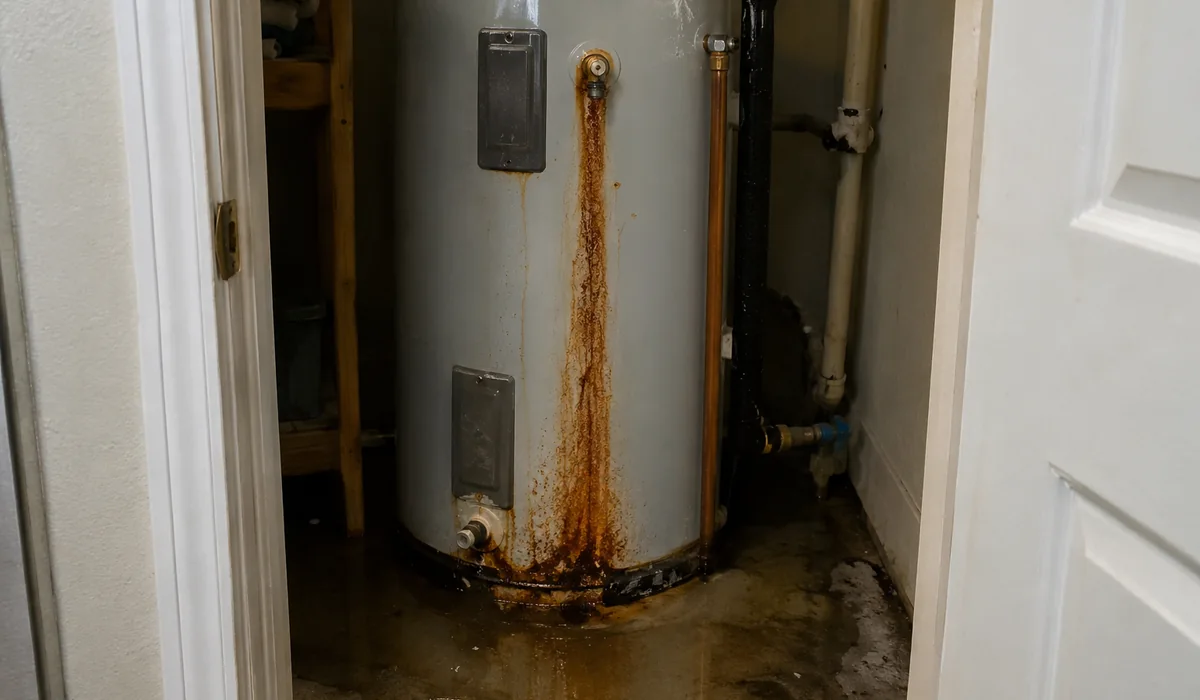
| Under the tank, from the tank body | Internal corrosion has eaten through the tank | Replace the water heater |
| Condensation (gas units) | Water forming on a cold tank after a big draw of hot water | Usually normal if it stops once the tank heats |
The relief valve: don’t cap it
Every tank water heater has a temperature and pressure (T&P) relief valve that opens when the tank gets too hot or the pressure too high. Water from its discharge pipe means it’s doing its job, or it has worn out. Never plug or cap it. Common causes when it keeps opening:
- High household water pressure. Plumbing codes call for a pressure-reducing valve when street pressure exceeds 80 psi.
- Thermal expansion. Heated water expands. In homes with a check valve or pressure-reducing valve, there’s nowhere for it to go unless an expansion tank is installed.
- A thermostat stuck on, overheating the water.
A plumber can test your pressure and the valve in minutes.
Why tanks fail
Inside every steel tank is a sacrificial anode rod that corrodes so the tank doesn’t. When the rod is used up, the tank itself starts to rust. Sediment that settles on the bottom adds stress and causes the popping or rumbling sound some heaters make.
The U.S. Department of Energy puts the typical life of a conventional storage water heater at 10 to 15 years, and a tankless unit at about 20 (Energy Saver). Rust-colored hot water, rumbling, and moisture at the base on a tank in that age range are signs it’s nearing the end.
Repair or replace?
Repair makes sense for a leaking fitting, drain valve, or relief valve, or a failed element or thermostat on a heater with years left.
Replace when the tank itself leaks, or when the heater is near or past 10 to 15 years and needs a significant repair. Replacement usually requires a permit, and current codes may require upgrades such as a drain pan, an expansion tank, or venting changes. See water heater repair for what’s involved.
What it costs
HomeAdvisor’s 2026 data puts water heater repair at $150 to $750 and installation of a new unit at $800 to $2,000 (HomeAdvisor). Our South Carolina plumber cost guide covers service call fees and after-hours rates.
Prevent leaks
- Flush sediment from the tank periodically, following the manufacturer’s instructions.
- Have the anode rod checked every few years.
- Test the relief valve once a year by lifting its lever briefly, with a bucket under the discharge pipe. If it doesn’t reseat, have it replaced.
- Install a drain pan with a drain line under heaters in closets, attics, or upper floors.
- Keep the thermostat at about 120°F, which the Department of Energy recommends for most households.
The bottom line
If you have a plumbing problem now, call (843) 459-7066 and we'll try to connect you with a participating independent plumber who serves your area. That plumber diagnoses the problem and quotes the job themselves.